
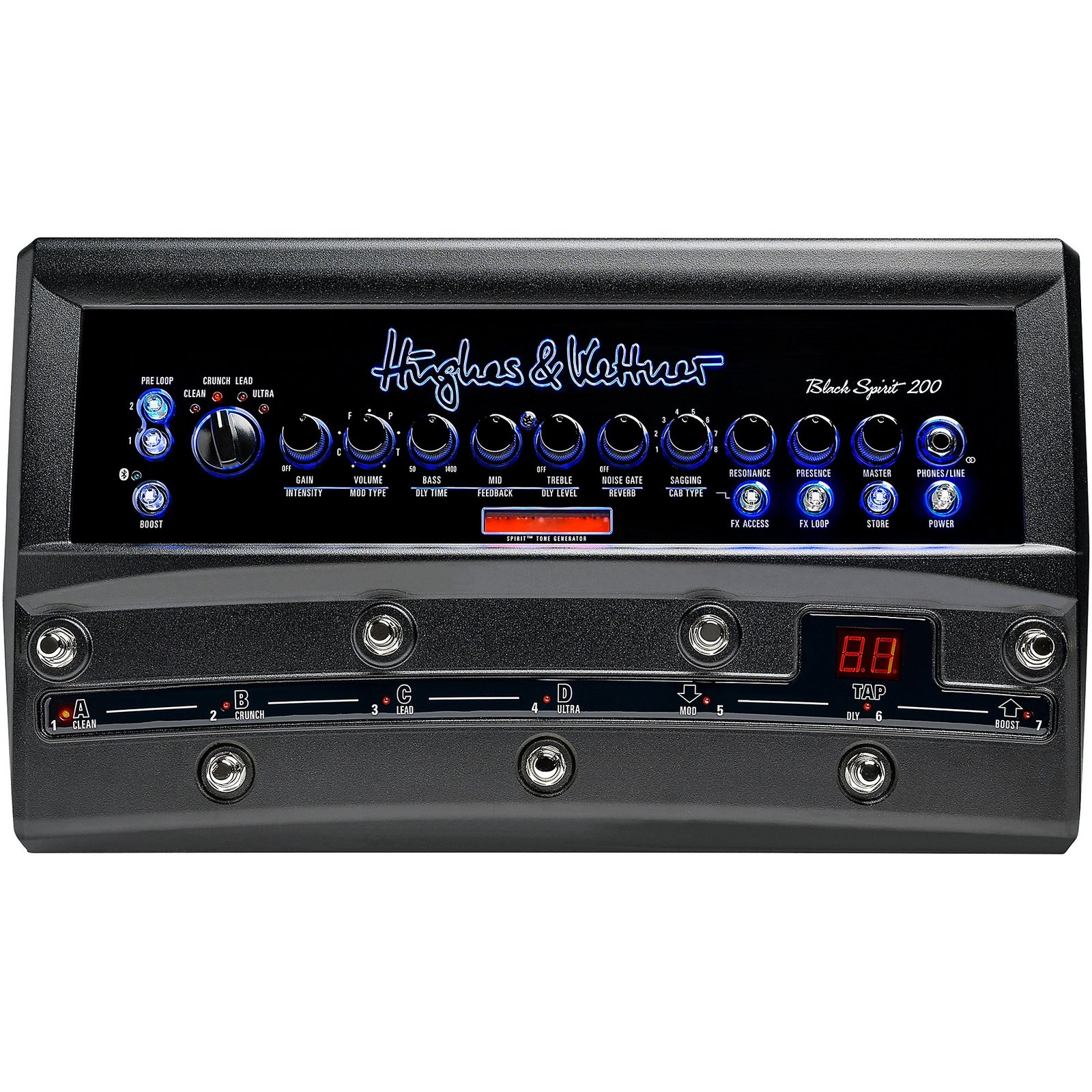
The Hughes & Kettner Spirit 200 Floor amp most often refers to the Black Spirit 200 Floor, a compact guitar amplifier built into a floorboard-style unit. It combines an analog preamp design, a 200-watt power stage and foot-controlled functions in one road-ready chassis. For guitarists who want amp-level tone shaping without carrying a traditional head and a separate pedalboard, the format is a central part of its appeal.
This guide explains what the Black Spirit 200 Floor offers, how its controls and output options fit different rigs, and what to check before purchasing. It is not a substitute for the current owner’s manual: speaker matching, electrical safety and firmware or app compatibility should always be checked against the exact unit and documentation.
What the Black Spirit 200 Floor Actually Is
The Floor model is not simply a multi-effects pedal that simulates an amplifier. Hughes & Kettner describes it as a floor-format version of its Black Spirit 200 platform, with four analog channels and an integrated 200-watt power amp. The product is designed to serve as a central guitar rig: the player can build tones, save presets, switch sounds with foot controls and connect to a cabinet or a direct recording or PA system.
The difference matters when comparing it with a standard pedalboard. A conventional pedalboard usually feeds an amplifier that provides the main preamp and power stage. The Black Spirit 200 Floor contains those amp functions itself. Depending on the performance situation, a guitarist can use a speaker cabinet, a full-range speaker, a monitor path or the direct output features described by the manufacturer.
Four Channels for Different Playing Styles
The manufacturer’s channel list includes Clean, Crunch, Lead and Ultra. Clean is intended for clearer headroom and articulate playing, making it a natural starting point for chords, arpeggios, funk parts and pedal-friendly sounds. Crunch supplies a more driven response for classic rock rhythm work and edge-of-breakup textures. Lead moves toward higher-gain sustain, while Ultra is aimed at heavier saturation and more aggressive parts.
These channel names are useful starting points rather than fixed genre labels. A player can shape the result with gain, volume, equalization and other programmable parameters. The guitar’s pickups, volume control, pick attack, cabinet and speaker all influence the finished sound. A high-output humbucker into a closed-back cabinet will not react exactly like a low-output single-coil into an open-back cabinet, even when the same preset is selected.
Spirit Tone Generator and Amplifier Response
Hughes & Kettner calls its underlying approach the Spirit Tone Generator. The company presents it as an analog design intended to capture the dynamic interaction and response that players associate with tube amplifiers, without using tubes in the signal path. The practical question for a buyer is not whether a marketing phrase sounds convincing; it is whether the amplifier responds naturally to picking, guitar-volume changes and the chosen cabinet.
Try the unit at realistic playing levels when possible. Listen to how a chord cleans up when the guitar volume is reduced, how single notes sustain, and whether the gain controls provide useful range rather than moving abruptly from clean to compressed. Record a short passage with the same guitar and cabinet you use regularly. A recording can reveal differences in attack, noise and frequency balance that are easy to miss in a busy showroom.
Built-In Effects and Noise Control
The published technical data lists reverb, delay and modulation effects. Modulation includes options such as chorus, phaser, flanger and tremolo. Having these sounds built into the amplifier can reduce the number of separate pedals needed for a compact live setup. It can also make preset changes easier because the stored sound may include amp parameters and effect settings together.
The amplifier also includes an Intelligent Dual Breakpoint noise gate. Noise control is particularly useful with higher-gain channels, but a gate should be adjusted with care. If the threshold is too aggressive, sustained notes may disappear unnaturally or the end of a bend may be cut short. Set the gate only high enough to manage unwanted hiss and hum in the actual room and rig. Different guitars and power environments may require different settings.
Power Soak: Different Output Levels
One of the unit’s practical features is its selectable power output or soak. The manufacturer’s technical information lists 200, 20, 2 and 0-watt settings. This gives players options for changing the power delivered to a connected speaker system, including a silent or direct-use scenario where appropriate. It can make the amplifier more flexible for rehearsal rooms, home playing, recording and stage work.
Do not interpret the power settings as a promise that every cabinet will be equally loud or that any speaker connection is safe. Speaker sensitivity, impedance, cabinet design and room acoustics affect the result. Follow the manual when connecting a cabinet, and never connect the speaker output to an input intended only for a line-level or instrument signal. Confirm which output should be used for a full-range monitor, a guitar cabinet or a recording interface.
Red Box AE+ and Direct Recording
The Red Box AE+ direct output is useful for players who need a consistent signal for a mixing desk, interface or PA. Hughes & Kettner lists eight cabinet emulations for this path. Cabinet simulation helps shape the frequency response so a direct signal is closer to the sound of a guitar speaker and microphone than an unfiltered amplifier signal would be.
For a live show, a direct feed can reduce dependence on a microphone positioned in front of the cabinet. For home recording, it can make setup quieter and quicker. The sound engineer may still ask for a cabinet microphone, a direct feed or both, depending on the stage and mix. Test the cabinet emulations and save the options that sit well in a dense arrangement. A sound that seems bright when played alone may need a different balance when drums, bass and vocals are present.
Connections and Rig Integration
The official specifications list a speaker output for 8–16-ohm loads, a serial effects loop and two additional pre-loops. The pre-loops provide a way to integrate external pedals into the signal path. There are also control connections for optional footswitches and expression pedals, a stereo auxiliary input, a headphone or line jack, MIDI input and output, Bluetooth remote functions and a dedicated monitor input.
These connections allow several different rig designs. A player might place time-based pedals in the serial effects loop, use a pre-loop for a specific overdrive or boost, and send a direct signal to front of house. Another guitarist might keep the setup simpler and use only the built-in effects. Draw a diagram before buying extra cables or adapters. Check connector type, signal level, stereo or mono behavior and the manual’s recommended routing for each device.
Preset Storage and Foot-Control Modes
The product page describes access to 128 presets and a Stomp-Box mode that allows the floor unit to be operated more like a pedalboard. It also highlights Direct-7 mode for direct access to favourite sounds. Presets are especially useful when a set list moves between clean, rhythm and lead sounds. A player can prepare changes in advance instead of making multiple knob adjustments between songs.
Before a show, test every preset at stage volume and with the actual cabinet or direct setup. A bedroom preset may be too bass-heavy or too loud in a band mix. Check that the footswitch assignments are logical, that tap tempo works with the delay settings you use, and that accidental button presses are unlikely during performance. Save a backup of important presets using the supported app or process described in the current manual.
Physical Design, Size and Portability
The published dimensions are approximately 410 × 155 × 150 millimetres, and the listed weight is about 3.6 kilograms. That is manageable compared with carrying a conventional amplifier head, a separate multi-switch controller and a collection of pedals. Its aluminium die-cast housing is described as road-worthy, but a robust enclosure does not eliminate the need for a padded case and sensible transport practices.
Measure the space on your pedalboard or stage before purchasing. Include room for the power cable, speaker cable, MIDI connections and foot movement. If the unit will sit on a crowded stage, make sure the controls and display remain visible and that the footswitches can be reached without hitting nearby pedals. For frequent travel, check case dimensions and airline or tour transport requirements as well.
Who Is This Amp Best Suited To?
The Black Spirit 200 Floor may suit guitarists who want a self-contained amp rig with foot control, programmable sounds and several output choices. It is worth considering for cover-band players who need quick channel and preset changes, recording guitarists who value a direct cabinet-emulated signal, and players who want to reduce the number of separate boxes in a live setup.
It may be less attractive to someone who prefers the simplicity of a traditional single-channel amplifier, wants a very specific tube-amp response, or already owns a complete rig that meets every need. The unit’s flexibility also means there are more settings to learn. A player who only uses one clean sound and one overdrive may not benefit from all its routing and preset functions.
What to Check Before Buying Used
Ask the seller to demonstrate all four channels, the footswitches, the display, the power soak, the effects loop and the direct output. Check that the speaker output works correctly and that the unit has not suffered impact damage around its jacks or footswitches. Test the power supply and inspect the mains connection. If Bluetooth or app control matters, confirm that the required device and operating system remain compatible with the current app.
Ask whether the original box, documentation, power cable and included accessories are present. Get the serial number and verify the exact model rather than assuming every Black Spirit 200 product has the same layout. Confirm whether the seller is offering the Floor version or a Head version. A written return period or in-person demonstration is valuable for used electronic equipment.
How to Compare It With a Traditional Amp and Pedalboard
Compare the total rig rather than the price of one box. A traditional head may need a cabinet, switching system, effects and transport case. The Floor unit combines several functions, but you may still need a cabinet, expression pedal, MIDI controller, cables or a full-range monitor. List what you already own and what would need to be purchased. The most economical solution is the one that meets your actual stage and recording needs, not necessarily the unit with the lowest sticker price.
Also think about repair and serviceability. A traditional amplifier and a separate pedalboard divide the system into components, which can be useful if one item fails. An integrated floor amp concentrates many functions in one device. Ask about warranty coverage, service options and availability of replacement accessories in your country. If you tour regularly, keep a simple backup plan for a technical failure.
Buying Checklist
- Will you use a guitar cabinet, full-range monitor, direct PA feed or a combination?
- Does your speaker cabinet fall within the impedance range specified by the manufacturer?
- Do you need MIDI, expression pedals, external effects loops or Bluetooth control?
- Will you use saved presets often enough to benefit from the floorboard workflow?
- Can you test the exact unit with your guitar and playing style?
- Does the price include a case, essential cables or other accessories you would otherwise need?
Frequently Asked Questions
Is the Hughes & Kettner Black Spirit 200 Floor a 200-watt amp?
Yes. The manufacturer lists a built-in 200-watt power amplifier. The unit also provides lower power-soak settings listed as 20, 2 and 0 watts.
Does it have four channels?
Yes. The stated channels are Clean, Crunch, Lead and Ultra. Their final sound depends on the programmable controls, guitar, cabinet and playing environment.
Can it connect directly to a PA or recording interface?
The Red Box AE+ direct output includes cabinet emulations and is designed for a direct signal path. Follow the manual and the sound engineer’s instructions for the correct connection.
Does the unit include effects?
The published specifications list reverb, delay and modulation effects, including chorus, phaser, flanger and tremolo.
Can I use it with a regular guitar cabinet?
The manufacturer lists a speaker output for 8–16-ohm loads. Confirm your cabinet’s impedance and follow the manual before connecting or powering the system.
Is the Floor model the same as the Black Spirit 200 Head?
They share the Black Spirit 200 platform, but their physical format and control arrangements differ. Check the model name and rear-panel connections before purchasing accessories.
Conclusion
The Hughes & Kettner Black Spirit 200 Floor brings four analog channels, a 200-watt power stage, built-in effects, programmable presets and direct-output options into a floorboard format. Its appeal is the ability to build a compact rig that can work for practice, recording and live performance. The best buying decision depends on whether its routing and foot-control flexibility solve real problems in your setup. Compare it with your current amplifier, test it at realistic volume, verify speaker compatibility and read the current manual before connecting your equipment. Official specifications are available on the Hughes & Kettner product page.
